The short version
Nicolae Romanescu Park is the best thing in Craiova and it is not a close contest. Ninety-six hectares, free, open at any hour, and designed by a Frenchman whose plan won a gold medal in Paris before a single tree was planted in it.
- Laid out 1900–1903 to a design by Émile Redont, the French landscape architect, whose plan took a gold medal at the 1900 Paris World Exposition.
- About 96 hectares — one of the largest parks in Romania, and larger than Bucharest's Herăstrău.
- Always free, at any hour. There has never been a ticket and there is no gate to close.
- Ten minutes' walk south of Piața Mihai Viteazul. A walk, not a journey.
- The zoo is inside it, which makes the two one trip rather than two.
Checked October 2026. The park itself needs no opening hours and charges nothing, so nothing on this page can go out of date. The zoo's hours are a different matter and are not reliably published — see the prices page.
Where it came from
The park was commissioned by Nicolae Romanescu, mayor of Craiova, who went to Paris, hired Redont, and then did the unusual thing of entering the design in the 1900 World Exposition before building it. It won gold. Construction ran from 1900 to 1903.
What matters about that sequence is what it tells you about the intent. This was not a municipal green space that grew; it was a single designed landscape, conceived whole by someone who did this professionally, at a moment when Craiova's grain money could pay for it — the same money and the same decade that produced the belle-époque facades along Calea Unirii and the Jean Mihail Palace.
A hundred and twenty-odd years later the structure of Redont's plan is still legible on the ground, which is the real reason the park reads as coherent rather than accumulated.
Places in this piece


What is actually in it
The lakes. The central water is the organising feature, with boats in season. Walk the edge rather than cutting across the lawns — the shaded lake path is both the better walk and, in summer, the only comfortable one.
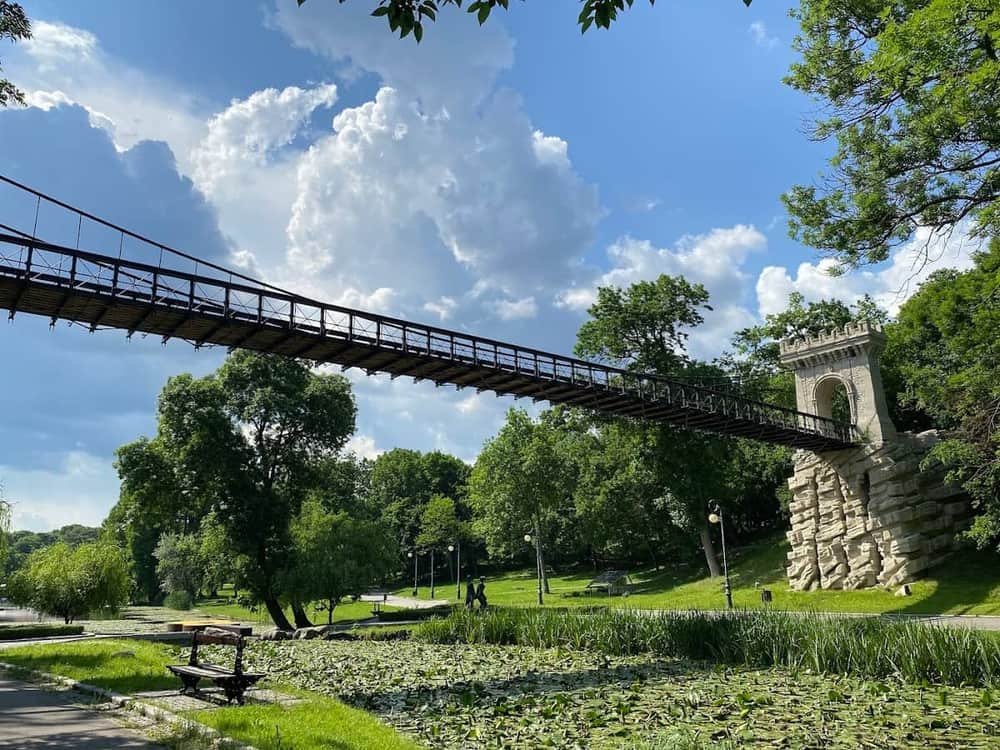
The suspension bridge. Genuinely exciting if you are seven, and worth crossing at any age. It is one of the set-pieces of the original design.
The mock ruined castle. A deliberate folly, built as a ruin, in the manner of the great nineteenth-century landscape parks. People reliably assume it is a real ruin and it is not.
The hippodrome. Part of the original scheme.
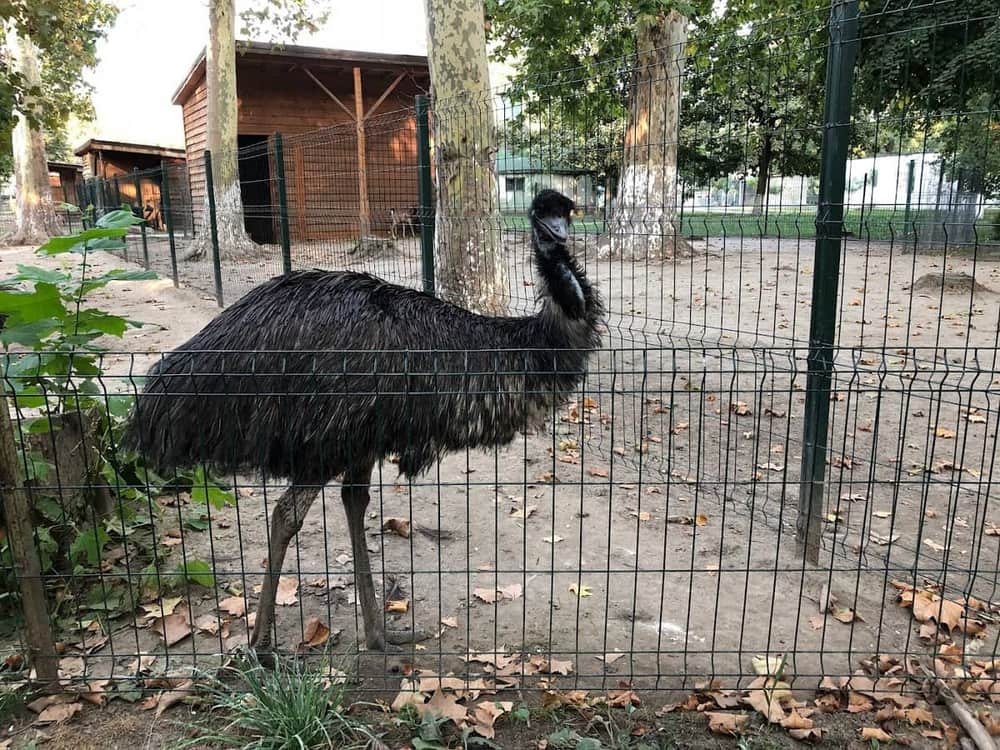
The zoo. Inside the park, holding a 4.5 from over three and a half thousand reviews. Honestly described it is a provincial zoo rather than a European flagship — and the practical consequence is in your favour: it takes an hour and a half rather than a day, and when the children have had enough there are ninety-six hectares immediately outside the gate. Check its hours before setting out.
Puskin Park adjoins it and is counted separately on most maps.
How to walk it
The park is big enough that you can get this wrong. Two routes:
The short loop, about forty-five minutes. In from the northern entrance, down to the lake, round the water, over the suspension bridge, back. This is the version that gets you the design.
The long wander, two to three hours. Add the castle, the far end, the zoo, and the paths that climb — the ground is not flat across the whole park, which is part of why Redont's plan works.
With children, allow that a four-year-old will be carried home and an eleven-year-old will still be finding things. See Craiova with children.
The season, month by month
April and May are the best months, without qualification. The planting comes back, the temperature is right for three hours on foot, and the park is at its busiest with locals rather than visitors — which is pleasant rather than otherwise.
June to August is when the park stops being a pleasure and becomes a necessity. Craiova averages a high of 30.0 °C in July on 358 hours of sunshine and 30.1 °C in August on 338 — these are climate normals, not a bad year, and the Oltenian plain has no sea breeze and no altitude to moderate it. The mature canopy here is the only large piece of shade in the city, and the temperature under it is noticeably lower than on Calea Unirii.
The crucial detail: stay on the shaded paths and the lake edges, not the open lawns. The park is large enough to get this wrong and spend an hour in full sun by accident. Before eleven and after six it is genuinely lovely. Beating the summer heat has the whole shape of a hot day, and if you have a car the proper escape is Rânca at 1,600 m.
September and October are the second good window, and arguably the prettiest.
November to March the park is bare, and this is the honest part: in winter Romanescu is not the reason to be in Craiova. The reason is the Christmas market in the centre from mid-November, and the problem with the park is not cold but fog — the Jiu valley holds damp air for days at a stretch and January averages only 131 hours of sunshine. See Craiova in winter.
Where to stay nearby
Live prices and availability on a map centred on this exact spot — hotels, apartments and hostels, so you can judge the walk from here rather than guess from an address.
Bookings made through this map earn us a commission. Your price is unaffected.
Getting there
On foot, ten minutes south from Piața Mihai Viteazul. This is the normal way and it is the right one.
By bus, which is worth it on a hot day when ten minutes in the sun is ten minutes too many. Getting around has the ticketing detail.
By car, if you must — but the centre is pedestrianised and you will be walking anyway. See where to park.
You do not need a car for any of this. Craiova without a car makes the fuller case: the city needs nothing, and it is Oltenia that needs a vehicle.
Eating around it
Better than a park's surroundings usually are. The Romanescu area holds four listed restaurants and four bars, which after the centre is as good as any district in the city:
- Restaurant Galaxy on Bulevardul Gheorghe Chițu and Mythos on Calea Unirii — the two with the review counts, and both a short walk from the northern entrance.
- Taverna To Petrino on Strada Eroilor and MRC House — quieter, and better for it.
- Epoca Steak House & Wine Bar — the best place in Craiova to drink a serious glass of wine sitting down. The wine page covers what to order.
There is no hotel inside the park's own area, which is worth saying plainly because several booking sites imply otherwise. The centre is ten minutes' walk north and has fifteen — and since the walk down is pleasant and the park never closes, that is the right arrangement anyway. If you want fish rather than a bed, Taverna Racilor is the city's obvious choice but it is 3 km east, inside the Electroputere Parc centre on Calea București, not by the park.
How it compares, honestly
If you are coming from Bucharest the comparison worth making is with Herăstrău: Romanescu is larger, older as a single designed landscape, and has perhaps a tenth of the people in it on a Saturday afternoon. That is the whole pitch and it is a good one — see a weekend in Craiova from Bucharest.
What it is not is a botanical collection. For that, the Alexandru Buia Botanical Garden belongs to the university, is far denser in planting, holds nearly nine thousand reviews, and is closer to the centre. The two are complementary rather than alternatives, and the parks page covers the rest of the green city — English Park, Parcul Tineretului, Parcul Trandafirilor and the smaller central squares.
Why it belongs in a one-day itinerary
Because Craiova divides cleanly into two halves and this is one of them. The centre — Calea Unirii, the Art Museum with its six Brâncuși originals, the museum quarter, the old town — is a morning. Romanescu is the afternoon. One day in Craiova is the timed version, and two days in Craiova adds the trip out into Oltenia.
A visit that skips the park has seen half the city, and the half it has seen is the one every provincial European city has.