
The short version
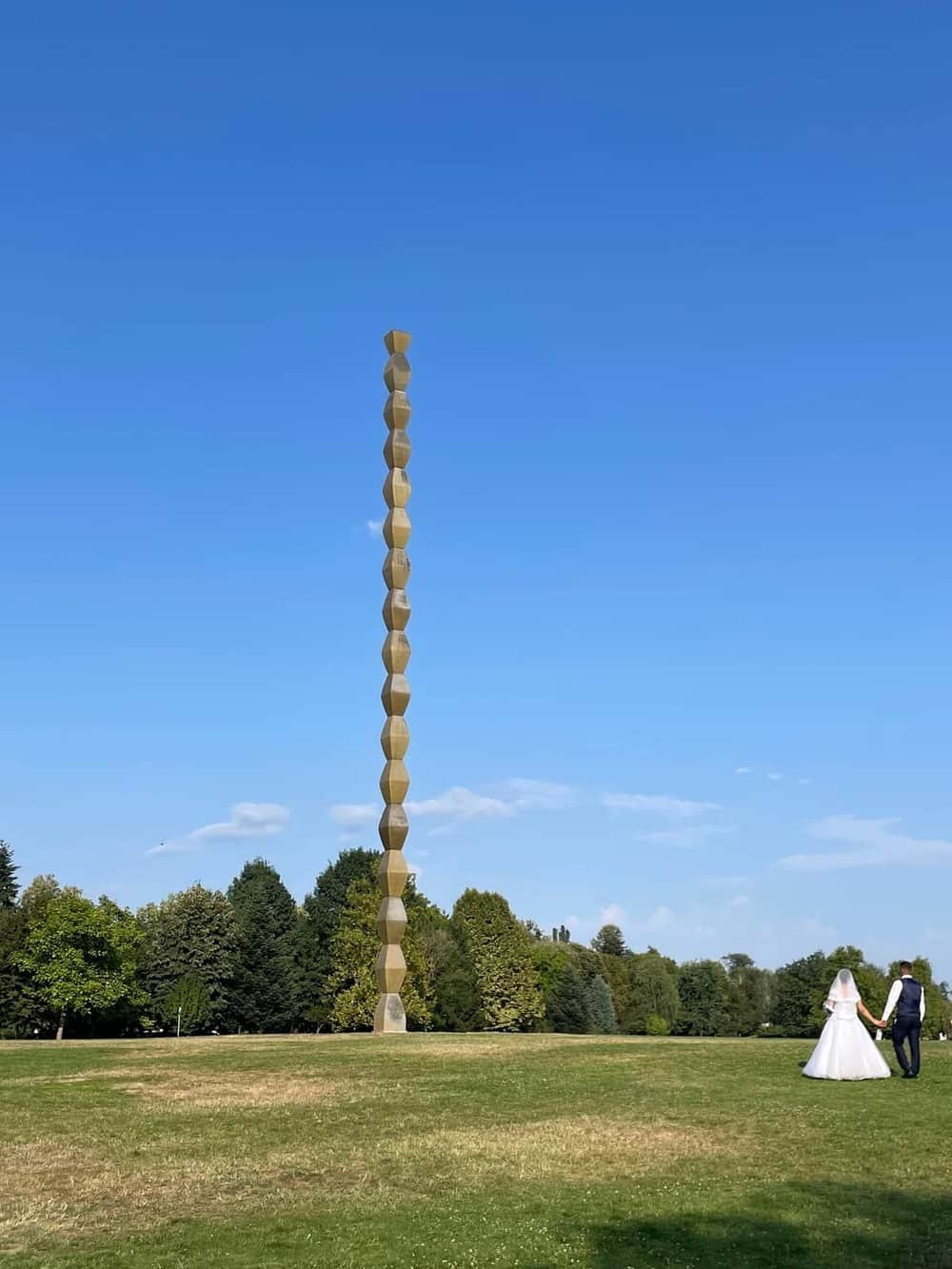
The Endless Column at Târgu Jiu is 29.33 metres of cast metal, made in 1938, standing in the open at the eastern end of a 1.3 km axis across the town. It is free, visible at any hour, lit after dark, and since 2024 it has been a UNESCO World Heritage Site as part of the Monumental Ensemble of Târgu Jiu.
- It is one third of a work, not a work. The Table of Silence, the Gate of the Kiss and the Column sit on one straight line, in that order, and Brâncuși meant them to be walked.
- The walk is about twenty-five minutes at an unhurried pace, through the central park and across the main street.
- 110 km north of Craiova, a measured 1 h 50 min. No useful public transport.
- Most visitors photograph the Column and leave, which misses the work entirely.
Checked October 2026. Drive times are measured on the roads rather than taken from a straight line. The ensemble is free and outdoors, so nothing here can go out of date in the way opening hours do — see the prices page for why that is worth saying in Oltenia.
What it is, physically
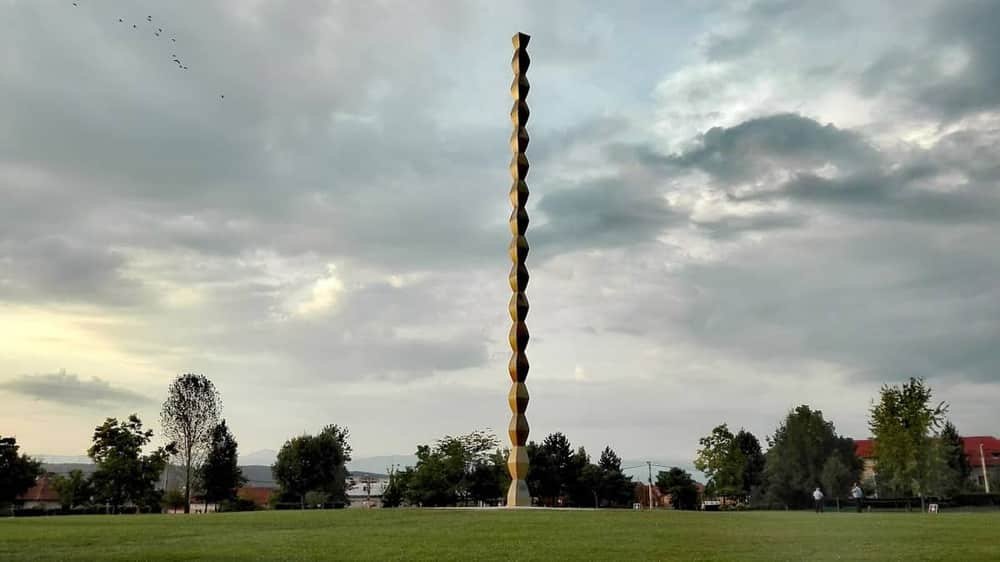
A stack of identical rhomboid modules — fifteen full ones and two halves at the ends — threaded on a steel core and rising to 29.33 m. The modules are cast metal, and the form is one Brâncuși had been working on in wood since the early 1920s: the *Column of the Infinite* exists in several smaller versions, and this is the one made monumental.
The crucial design decision is the half-module at the top. The column does not finish; it is cut off mid-unit, so the eye continues the sequence past the physical end of the object. That is the whole idea, and it is why the name is *endless* rather than *tall*.
It was commissioned as a First World War memorial, to the people of Gorj who died in the 1916 defence of the Jiu, and completed in 1938.
Places in this piece

Why the axis matters more than the Column
This is the part the photographs cannot carry, and the reason to go rather than to look it up.
Brâncuși laid out three works on a single straight line running west to east across Târgu Jiu:
- The Table of Silence — a round stone table with twelve stools, by the Jiu, at the western end.
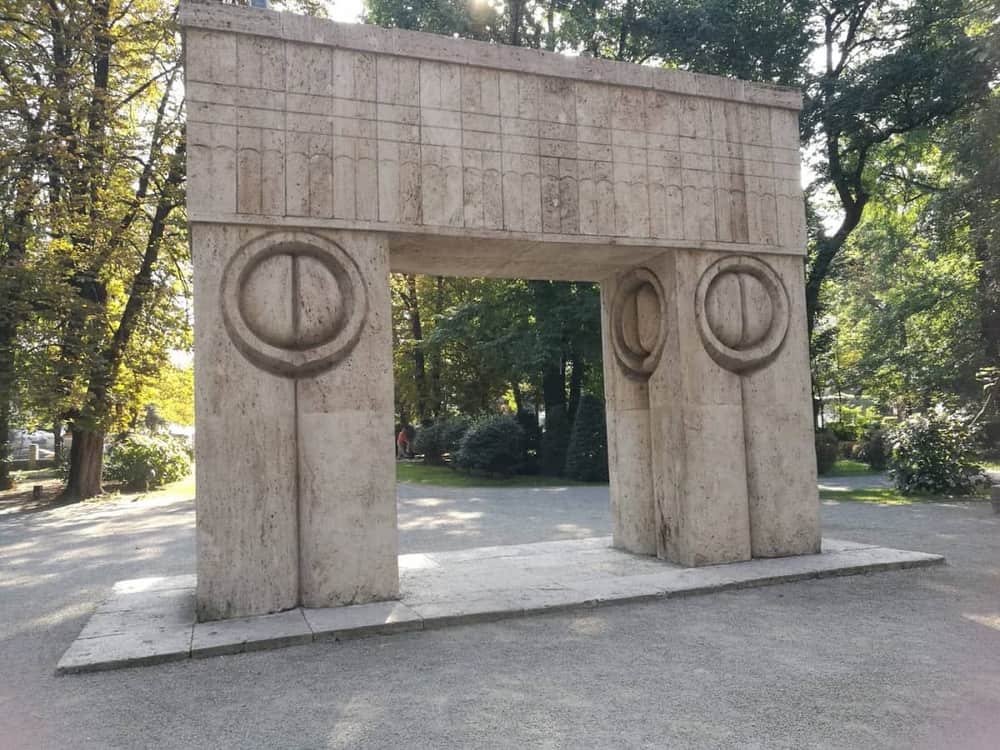
- The Gate of the Kiss — a stone portal, in the park, carrying the kiss motif he had been cutting since 1907.
- The Column — 1.3 km east, past the park and across the town's main street.
Walked in that order the sequence reads as a progression: a gathering, a passage, an ascent. Walked in reverse, or seen only at one end, it is three sculptures in a town. The axis is the piece, and the twenty-five minutes between the Table and the Column are part of it rather than a transit between exhibits.
The practical consequence: park at the Table of Silence end, not at the Column. Nearly everyone does the opposite, because the Column is what they came for and it is what the signs point at.
The restoration, which is worth knowing about
The Column has not had an untroubled life. By the 1990s the metal was in poor condition and a restoration was carried out between the mid-1990s and 2000, which involved dismantling the modules, treating them and re-coating the surface.
It was contentious at the time and remains so among conservators, for the usual reason: a work whose material surface is part of its meaning cannot be re-surfaced without changing it. What you see today is the 1938 object, restored — not a reconstruction, but not untouched either. Whether that distinction troubles you is a matter for you; it is mentioned here because nothing on site mentions it.
The 2024 UNESCO inscription covers the ensemble as a whole, under the name Brâncuși's Monumental Ensemble of Târgu Jiu.
Where to stay nearby
Live prices and availability on a map centred on this exact spot — hotels, apartments and hostels, so you can judge the walk from here rather than guess from an address.
Bookings made through this map earn us a commission. Your price is unaffected.
When to go, and when the Column is best
After dark. The Column is lit, and this is genuinely the better visit — the modules read as a repeating silhouette against the sky in a way they do not in flat daylight, and the half-unit at the top disappears into the dark, which is the effect the form is built for.
Early morning in summer. July averages a high of 30.0 °C in this region and August 30.1 °C, and the whole ensemble is outdoors with a 1.3 km walk in it. Eight in the morning or after six in the evening; not two in the afternoon. Beating the summer heat has the shape of a hot day.
Autumn is the best season. The park the Gate stands in is at its best in October, and the drive up from Craiova is the better half of the trip at 18 °C.
Winter works. Everything is free and outdoors and there is no queue in February. The caveat is fog — the Jiu valley holds damp air for days at a stretch, and a Column you cannot see is not worth two hours of driving. See Craiova in winter and check the forecast.
Reading it against the Craiova end
This is the argument for doing Craiova and Târgu Jiu as one trip rather than two, and it is the whole editorial premise of this site.
The Craiova Art Museum holds six Brâncuși originals, including a student head modelled in 1898 and *The Kiss* of 1907. He enrolled at the School of Arts and Crafts in Craiova in 1894, four streets from where those pieces now stand.
So: 1898 and 1907 in a museum in Craiova; 1938 in the open air at Târgu Jiu, 110 km north. Forty years, the beginning and the end, and the kiss motif appearing at both ends of it — in a stone block in 1907 and in a monumental portal thirty years later.
Seeing the museum on one day and the ensemble on the next is the two-day trip this site is built around. Brâncuși makes the case, the Art Museum covers the Craiova half, and two days in Craiova is the itinerary.
Getting there
110 km north of Craiova, measured at 1 h 50 min. The road runs up through Gorj.
No useful public transport. The train takes most of a day with a change, which makes it a poor use of a short trip. This is a car trip, and Craiova without a car is honest about which Oltenian destinations are and are not reachable otherwise.
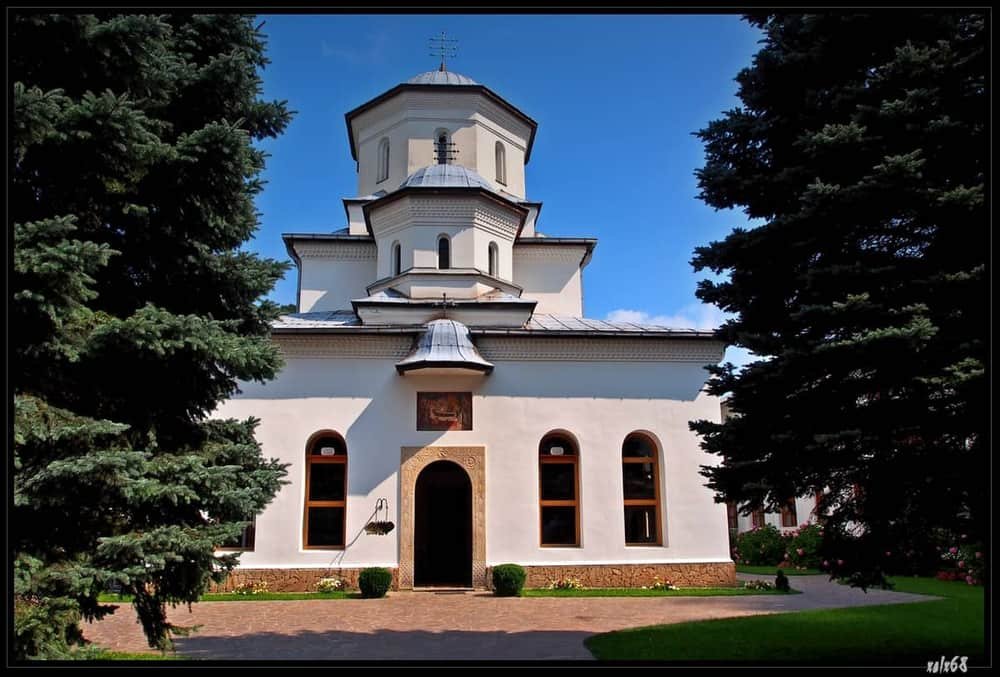
What to pair it with. Tismana monastery is 20 km further on — the oldest surviving monastic foundation in Wallachia, begun by Saint Nicodim in the 1370s on a rock above the gorge, with a waterfall behind the church. That makes a genuinely full day.
What not to pair it with. Horezu and Peștera Muierilor. They are two hours away on the opposite side of Craiova. People try this and spend six hours in a car.
Where to eat. Târgu Jiu has sixteen listed restaurants, more than any other town in this section — Terasa ANNA, Ambasador and Casa Vera are the three with both ratings and volume. Nine places to stay, if one day turns out not to be enough.
With children
Better than it sounds. The Column is 29 metres of shining metal and children reliably like it; the walk between the three pieces runs through the Park of the Infinite Column and the town's central park, so it is a park walk with sculpture in it rather than a gallery visit. Islet's Park is the other green space in town.
Craiova with children sets out which other Oltenian trips work and which do not.
The one thing to do differently from everyone else
Start at the Table of Silence, walk east, and let the Column arrive at the end of twenty-five minutes rather than at the end of a car park.
That is the only instruction on this page that will change what you see.










