
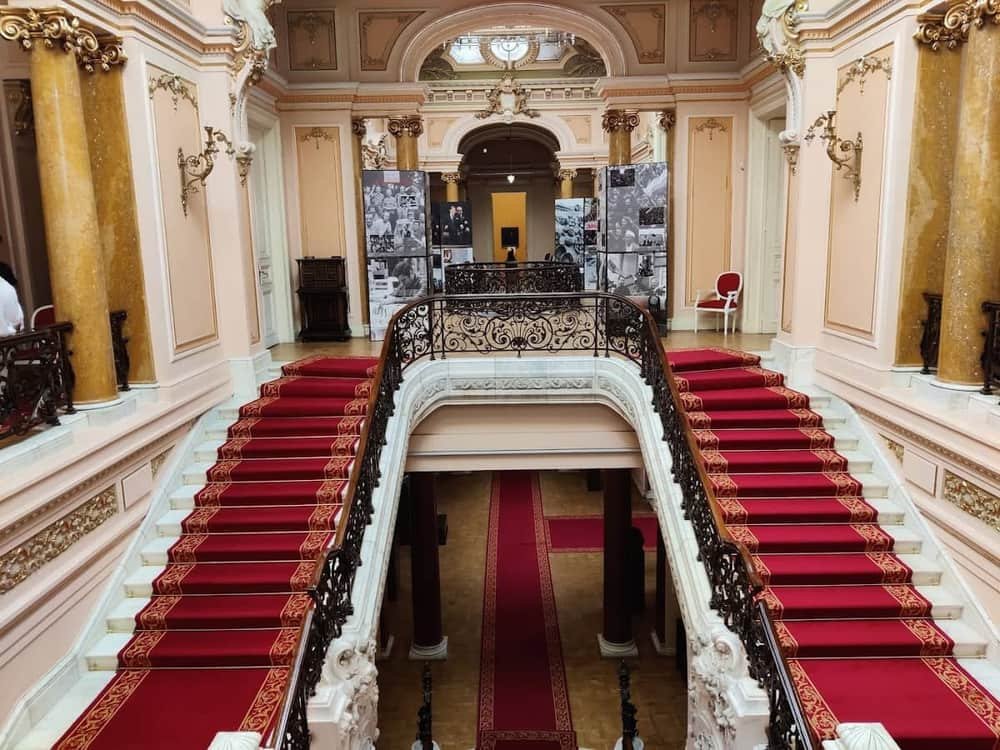
The short version
Brâncuși was Oltenian. He was born in Hobița, in Gorj, in 1876 — the same county as the monumental ensemble he would build sixty years later — and the four years he spent as a student in Craiova, from 1894 to 1898, are where he learned to carve.
- He enrolled at Craiova's School of Arts and Crafts in 1894 and finished in 1898.
- He was in the city at exactly the moment the grain money was building it, which is a coincidence of timing worth noticing.
- The Art Museum holds the student head of 1898 — made while he was still at the school, four streets away — and ***The Kiss* of 1907** in the same room.
- Then Bucharest, 1898–1902, and then Paris.
Checked October 2026. The dates and the works in the museum are matters of record. The famous story about how he got into the school is traditional rather than documented, and this page says so where it tells it.
Hobița, and why it matters that he was from here
Brâncuși was born in 1876 in the village of Hobița, in Gorj — about thirty kilometres from Târgu Jiu and in the hills north of the Oltenian plain. His family were peasants, and the carving tradition he grew up around was the ordinary vernacular woodwork of Gorj: gate posts, house beams, the geometry of a region that decorated its buildings by cutting them.
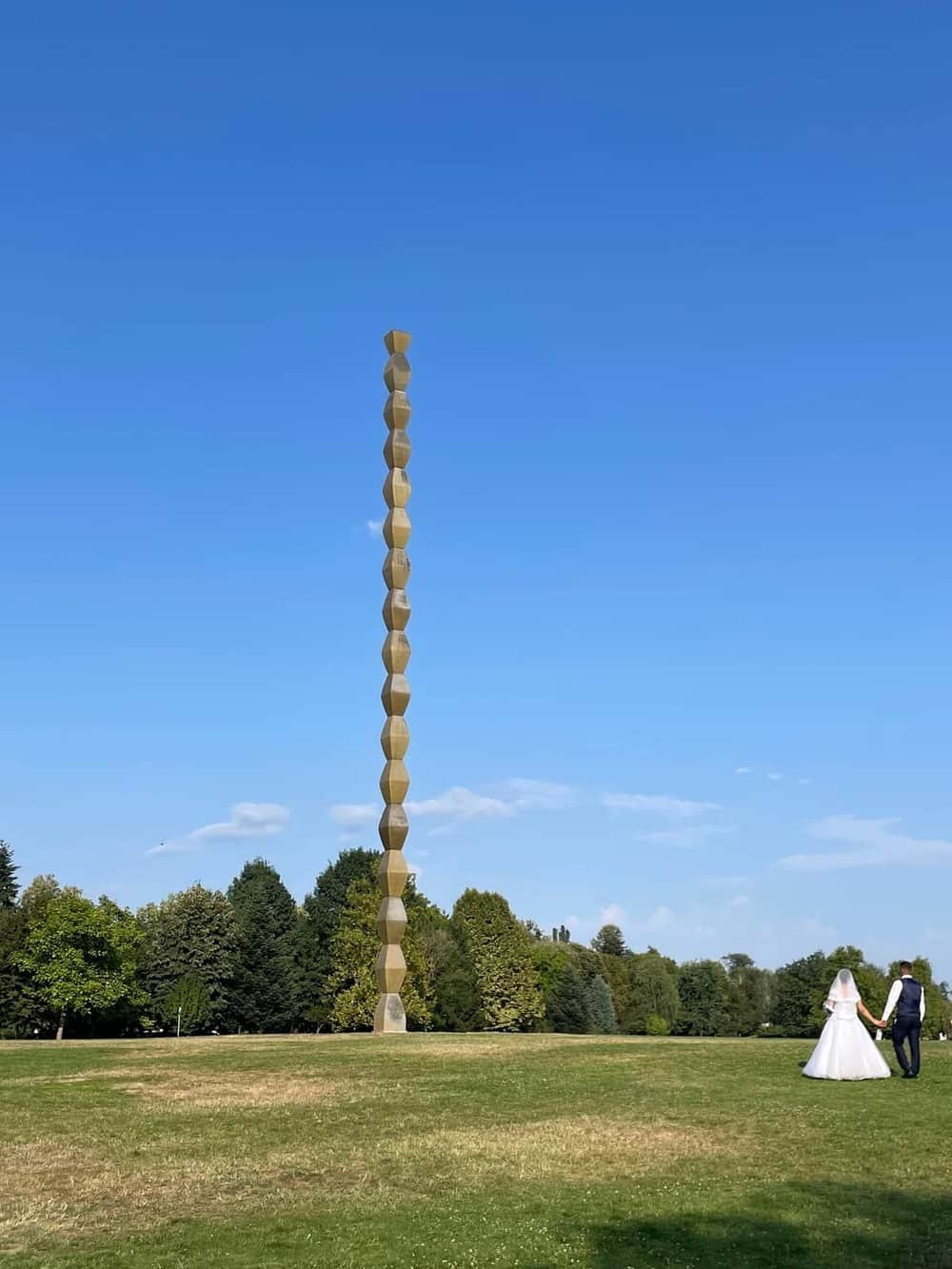
This matters for a specific reason. The rhomboid module of the Infinite Column — stacked fifteen times and cut off at the top so the eye continues past the object — is a form with a clear relationship to Gorj vernacular carving. The most radical sculpture of the twentieth century has a genealogy, and it runs through the wooden posts of the county the column stands in.
So: he came from Gorj, he trained in Craiova, he worked in Paris for fifty years, and he came back to Gorj in 1937–38 to build the thing he is most known for. The whole arc is contained within a hundred and ten kilometres of road.
Places in this piece


The violin story
Every account of Brâncuși's early life tells this story and it is worth both telling and flagging.
He left home young and worked a succession of jobs in Craiova — a dyer's, a grocery. The traditional account is that while working in a grocer's shop, aged around eighteen, he built a violin out of the wood of a packing crate, using a knife and whatever he had; a customer saw it, recognised that something unusual was happening, and arranged or funded his entry to the School of Arts and Crafts.
The story is told everywhere, including by the institutions, and it is plausible. It is also the kind of origin anecdote that accretes detail with retelling — the kind of crate, the name of the grocer and the identity of the customer vary between versions — and it is not documented in the way his enrolment is.
Take it as what it is: a tradition the city holds about itself, probably true in outline, unverifiable in detail.
The school
He enrolled at the School of Arts and Crafts in Craiova in 1894 and completed the course in 1898, finishing with distinction.
What such a school taught was craft rather than art: joinery, carving, furniture, the technical vocabulary of making things in wood and stone to a professional standard. That is not a detour on the way to being a sculptor — it is the foundation that distinguishes his work from that of contemporaries who came to sculpture through drawing. Brâncuși could cut stone himself, to the end, and he preferred to; the direct carving that defines his practice is a skill he acquired in this city.
He went on to the School of Fine Arts in Bucharest, 1898 to 1902, and then to Paris, arriving in 1904 after a journey he completed substantially on foot.
Where to stay nearby
Live prices and availability on a map centred on this exact spot — hotels, apartments and hostels, so you can judge the walk from here rather than guess from an address.
Bookings made through this map earn us a commission. Your price is unaffected.
What is in the museum, and why the room works
Two pieces in the Craiova Art Museum do the work, and they are in the same room:
The student head, 1898. Modelled while he was at the school or immediately after it. It is competent, academic, carefully observed — a young man demonstrating that he can do the thing being taught. Nothing has been removed.
***The Kiss*, 1907.** Two figures barely separated from a single block, features cut as incisions, the embrace read rather than depicted. Routinely called the first modern sculpture of the twentieth century, and the beginning of a series he returned to for four decades.
Nine years separate them. That gap, visible in one room, is the whole argument of modern sculpture — and it is visible here, in the city where the first of the two was made, rather than in a reproduction.
Six Brâncuși originals are in the museum altogether, which is the largest group in any Romanian museum outside Bucharest. The building is the Jean Mihail Palace of 1900–07, which was going up while he was in Bucharest.
A practical note: the museum does not publish a dependable timetable, and *The Kiss* has been lent out for temporary exhibitions before. Telephone before travelling specifically for it. The prices page explains why this warning recurs across the site.
The coincidence of timing
Brâncuși was a student in Craiova from 1894 to 1898. Calea Unirii's belle-époque facades, the Jean Mihail Palace and Romanescu Park were built between roughly 1880 and 1914 on the proceeds of the Dolj grain trade.
So the city he trained in was in the middle of the one period of serious wealth it has ever had, building at a scale and with an ambition it has not matched since. A provincial school of arts and crafts in a town that was suddenly rich, employing craftsmen on new buildings, is a plausible place for a peasant boy from Gorj to learn to cut stone properly.
That is not a documented causal claim — it is context. But it is the right context, and it is why a short history of Craiova and this page belong next to each other.
Doing the whole thing
The two ends of his career are 110 km apart, and seeing both is the trip this site is built around.
In Craiova: the Art Museum — six originals, the 1898 head and *The Kiss* — and the knowledge that the school was four streets away. An hour, and the best hour the city centre offers.
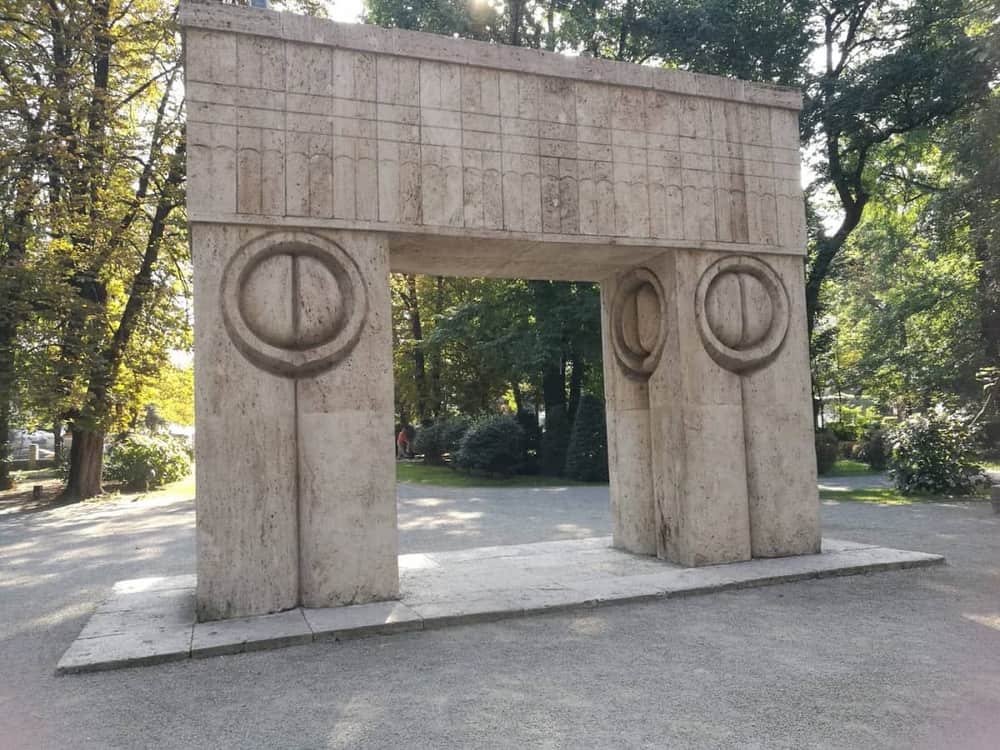
At Târgu Jiu: the Table of Silence, the Gate of the Kiss and the Infinite Column, on one straight 1.3 km axis across the town. Made 1937–38 as a First World War memorial, free, outdoors at any hour, lit after dark, and a UNESCO World Heritage Site since 2024. A measured 1 h 50 min from Craiova by road; no useful public transport.
The kiss appears at both ends — cut into a stone block in 1907 and built as a monumental portal thirty years later. That is the single best reason to do the museum one day and the ensemble the next, which is exactly the shape of two days in Craiova. The Brâncuși page makes the case in full.
What you will not find
A Brâncuși house-museum in Craiova. There is none. The school building's connection is institutional rather than preserved as a shrine, and there is no reconstructed workshop.
A birthplace visit that is on the way to anything. Hobița is in Gorj, reachable, and a detour rather than a stop. Most visitors do the museum and the ensemble and leave the village to the specialists, which is the right call for a two-day trip.
Much signage. The museum labels the works; nothing in the city explains the biography at length, and nothing at Târgu Jiu explains the Gorj carving connection or the 1990s restoration. That gap is why this page exists.










