A friend from abroad asked me last year to book her a walking tour of Craiova. I said I would look into it. Two hours later I had found almost nothing, and I had to go back and offer to do it myself.
This is not a small gap. It is the clearest symptom of something structural about how this city relates to visitors, and it is worth being honest about.
What is actually missing
Not everything. The city has museums with staff, a tourist-facing art museum, signage in the centre and hotels that answer the phone.
What it does not reliably have is the intermediate layer: scheduled walking tours, a regular English-language city tour, an easy booking surface, somebody at nine on a Tuesday morning whose job is to show up and talk for ninety minutes.
In most European cities of this size that layer exists even where the sights are thinner. Here it mostly does not.
Places in this piece


Why there are no guides: the demand problem
A guide needs a predictable flow of people. Craiova has a visitor flow that is spiky and seasonal rather than steady.
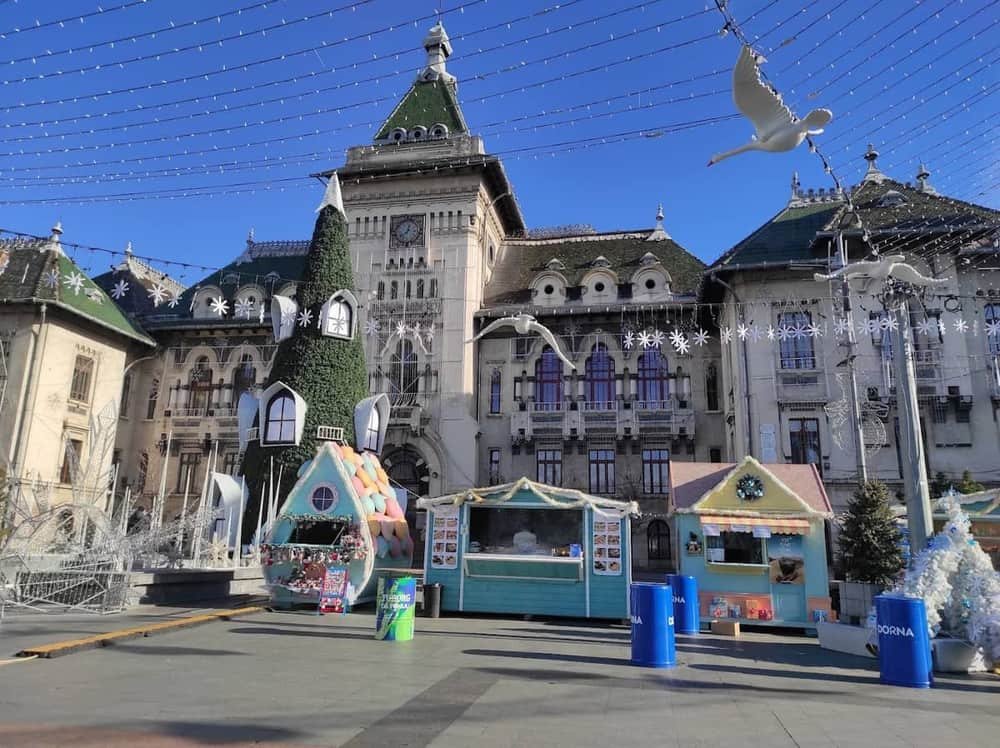
The Christmas market brings a genuine crowd for about six weeks. The Shakespeare Festival brings an international audience, biennially. For the rest of the year the arrivals are business travel to the car plant, family visits, and the occasional curious driver.
You cannot build a job on six good weeks and a festival every other year.
Why there are no guides: the geography problem
The second reason is that the best thing to show somebody is an hour and a half away.
If you are a guide in this region, the commercially sensible product is a day trip to Brâncuși at Târgu Jiu, Horezu or the cave — a full day, a decent fee, a transport markup. A ninety-minute walk around Calea Unirii is worth a fraction of that.
So the guiding capacity that does exist points out of the city, not around it. Craiova and the rest of Oltenia is the structural version of this.
Why there are no guides: nobody thinks the city needs explaining
This is the local-attitude part, and I include myself.
Craiovenii genuinely do not think of the city as a thing requiring interpretation. It is where we live. The palaces are offices, the park is where you take the children, the market is where you buy tomatoes.
It takes a visitor asking "who built this and why" to notice that there is a two-hour answer — and that the answer is good.
Where to stay nearby
Live prices and availability on a map centred on this exact spot — hotels, apartments and hostels, so you can judge the walk from here rather than guess from an address.
Bookings made through this map earn us a commission. Your price is unaffected.
What this costs the city
Three things, and they compound.
- Visitors under-stay. Without somebody to frame it, Craiova reads as a pleasant street and a park, which is a half-day proposition. With framing it is comfortably two days — see two days in Craiova.
- The best assets stay invisible. Six original Brâncuși in a Belle Époque palace is a headline anywhere else. Here it is a room you might wander into.
- Nothing compounds. Tour operators sell what is easy to sell. A city with no product does not enter the catalogues, which is a large part of why nobody knows about Craiova.
What to do instead, practically
Since this is a blog and not a complaint, the workarounds:
- Use the museums as your guide. The art museum and the Oltenia Museum have staff who know their material and are usually delighted to be asked.
- Walk the route yourself with context. The Belle Époque walk and Calea Unirii are written to be used in the street.
- Book the day trip, not the city tour. If you want a guided experience in this region, the Oltenia day trips are where the capacity is.
- Ask a local. Genuinely. The absence of a tourism industry means people are not tired of visitors yet.
The thing that would change it
One operator running a reliable, scheduled, bookable English and Romanian city walk, three times a week, for two years.
That is it. Not a strategy, not a campaign — one person being predictably available. The material is already here; the history, the palaces, the park and the speech are a ninety-minute walk with no filler in it.
Why I am writing this down
Partly so visitors stop wasting an afternoon searching, and partly because the gap is an opportunity sitting in plain sight.
If you run tours and you are reading this: the city opens its Christmas market before Sibiu's, has a museum nobody expects, and currently has no competition. The partners page exists for exactly this sort of conversation.