
The short version
Marin Sorescu (1936–1996) is the writer Craiova's National Theatre is named after, one of the most translated Romanian poets of the twentieth century, and — briefly — Romania's minister of culture.
He was born in Bulzești, Dolj county, about an hour north-west of Craiova. That detail is not biographical trivia. The most original thing he wrote is a poetry sequence set in a Dolj village, written in the speech of one, and it is impossible to separate from the Oltenian way of talking.

The essentials
| Born | 1936, Bulzești, Dolj |
| Died | 1996 |
| Known for | poetry, plays, essays |
| *Iona* (play) | published 1968 |
| *La Lilieci* (poems) | three volumes, 1973, 1977, 1980 |
| Minister of Culture | 25 November 1993 – 5 May 1995 |
Places in this piece
*Iona*, and why the plays travelled
*Iona* — Jonah — was published in 1968 and is generally treated as his masterpiece. A man inside a fish cuts his way out, and finds himself inside another fish. Then another.
It is a parable about enclosure written in a country where enclosure was the daily condition, and it got past the censors because a parable is not a pamphlet. That is the characteristic Sorescu manoeuvre and it is why his work exported well: the situations are universal enough to stage anywhere and specific enough that everybody at home knew exactly what was meant.
His theatre is a large part of why Craiova's stage reputation is what it is, though the two careers are separate — see the National Theatre for the company's own story.
*La Lilieci*, which is the real monument
Between 1973 and 1980 he published three volumes of *La Lilieci*, named after the cemetery of his native village. Later volumes followed.
It is a poetry cycle built out of overheard village speech — gossip, funerals, field talk, the dead addressed as neighbours — written in the vocabulary and rhythm of Oltenian country Romanian rather than in literary standard. Nothing quite like it exists in the language.
Where to stay nearby
Live prices and availability on a map centred on this exact spot — hotels, apartments and hostels, so you can judge the walk from here rather than guess from an address.
Bookings made through this map earn us a commission. Your price is unaffected.
The minister
He was minister of culture from 25 November 1993 to 5 May 1995, under prime minister Nicolae Văcăroiu. Seventeen months.
Romanian writers who took office in the 1990s tend to attract either indignation or hagiography and rarely much else; the useful thing to know is the duration, the dates and that it is a small part of a long career. He died in 1996, the year after leaving office.
Where you encounter him in Craiova
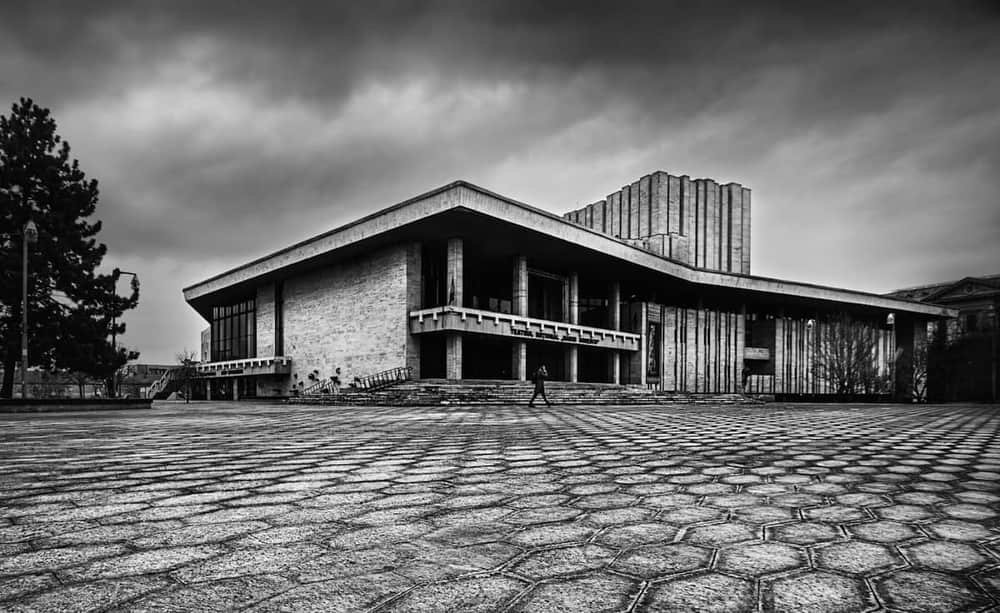
- The National Theatre "Marin Sorescu" carries his name — adopted after 1989; before that it was simply the National Theatre of Craiova.
- The Shakespeare Festival, the city's biggest cultural event, happens in the house that bears his name.
- The bookshops. His work is in print, cheap and everywhere, which is not true of most twentieth-century Romanian poets. See shopping in Craiova.
- Bulzești itself is a drive, not a day trip, and there is no visitor infrastructure. Set expectations accordingly.
The generation, and why so many of them were from here
Sorescu belongs to a cohort of Romanian writers who were born in villages in the 1930s, educated in the 1950s under a state that was simultaneously opening higher education to peasants' children and closing nearly everything else, and published from the mid-1960s when censorship briefly loosened.
Oltenia produced an unusual number of them, and the mechanism is not mysterious. It was poor, overwhelmingly rural and well supplied with schools after the war — which meant a large population of clever children whose only route out ran through examinations, and a region whose spoken culture was still intact enough to be worth writing down by the time they were old enough to notice it was disappearing.
If you want to read him in English
He translated unusually well and was published in English during his lifetime — rare for a Romanian poet of his generation. Start with the selected poems rather than the plays: the voice is dry, concrete and funny, and it survives the crossing better than the theatre does.
Further reading on this site
The National Theatre for the institution. Oltenian speech for the language *La Lilieci* is written in. Amza Pellea for the other Dolj figure who made the region's own voice into a national one, from the opposite direction. And the history of Craiova for the city they both came to.
*Dates and publication details here come from encyclopaedic sources, a Romanian press agency and literary publishers; reviewed as a source set in October 2026. The birth-date disagreement is printed above rather than resolved.*










