The short version
Craiova's districts are named after four different things, and once you can tell them apart the map stops being a list of syllables and starts being a history.
The four sources: ancient earthworks, old landscape features, roads out of town, and the calendar of a political regime. Most Romanian cities have the same four layers; Craiova's are unusually legible because its expansion happened so fast and so recently.

Layer one: the earthwork
Brazda lui Novac — "Novac's furrow".
The district is named after a linear earthwork that crosses Oltenia, traditionally attributed to a legendary strongman called Novac who is supposed to have ploughed it with a team of oxen. Scholarship generally places it in the Roman period, as a frontier or military work.
A housing estate of tower blocks named after a prehistoric or Roman rampart is a good summary of how Romanian urban naming works.
Places in this piece
Layer two: the landscape that was there first
These are the oldest and the most informative, because they describe a place that no longer looks like its name.
| Name | What it means | What it tells you |
|---|---|---|
| Valea Roșie | "red valley" | there was a valley, and the soil was red |
| Balta Verde | "green pond" | wet, low ground south of the centre |
| Craiovița Nouă | "new little Craiova" | a satellite settlement that got absorbed |
Craiovița is the one worth pausing on. The diminutive — *-ița* — means it was a smaller Craiova beside the real one, a village in the city's orbit. Then the 1970s and 1980s arrived and the "little" one became one of the largest housing districts in Romania, built for the workforce of Electroputere and the car plant. The name is now exactly backwards, and nobody has ever proposed changing it.
Layer three: the roads
Calea București is the Bucharest road, and Gara–Brâncuși is the station plus a street name. Lăpuș–Argeș takes its name from streets.
This is the most functional kind of naming and the easiest to navigate by: a *cale* in Romanian is a road leading somewhere, so the name tells you the direction before you look at a map. Calea Unirii, the central pedestrian axis, belongs to the same family.
Where to stay nearby
Live prices and availability on a map centred on this exact spot — hotels, apartments and hostels, so you can judge the walk from here rather than guess from an address.
Bookings made through this map earn us a commission. Your price is unaffected.
Layer four: the regime's calendar
1 Mai — the first of May, International Workers' Day.
Districts named for dates are the signature of the post-war period, and Romania has them everywhere. What is interesting about Craiova's is how little fuss there has been about it: the name survived 1989 without the renaming battles other cities had, and it is now simply what the area is called.
What the names tell a visitor
More than you would think.
- **A *cale* name means a main road out of town.** Good for buses, bad for quiet.
- A landscape name usually means the ground was low or wet. Which is why some of these areas were built late.
- A diminutive means it was once a village. Craiovița is the clearest case.
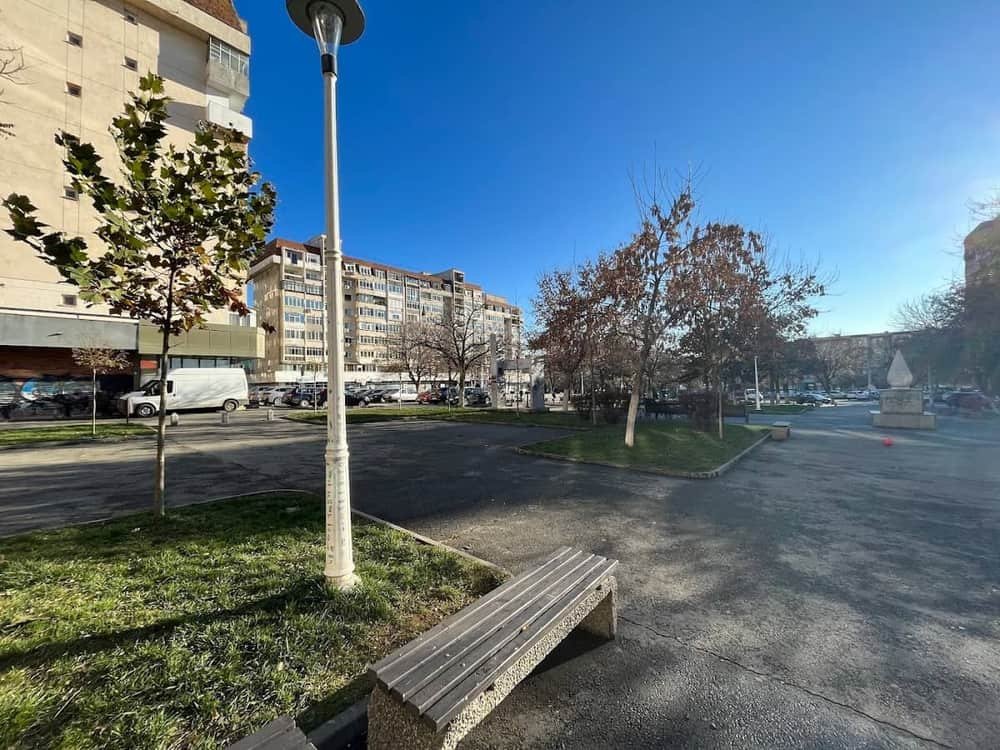
- A date means it was planned. Expect wide streets, blocks and generous green space between them.
The neighbourhood pages cover what each area is actually like today, with what is open and what is worth going for.
Rovine, the name that is not a district
You will see Rovine on a park and on signage — Grădina Rovine — and it belongs to a different register entirely. Rovine is the name of a medieval battle fought against an Ottoman army, one of the set pieces of Romanian historical memory.
Naming a garden after a battle is the nineteenth-century patriotic habit, not the socialist one. It sits alongside the statues and monuments of the same period and the same impulse that put Michael the Brave in the central square.
Further reading on this site
The neighbourhoods for what each one is like now. The history of Craiova and Electroputere for why the big districts exist at all. Craiova's geography for the flat ground that let them spread.
*Toponymy here follows general Romanian usage and local naming; where a popular etymology is disputed — the Brazda above all — the dispute is stated rather than smoothed over. Reviewed October 2026.*