Mention football to a Craiovean and you will not get a neutral answer. You will get a long one, and somewhere in the first two minutes it will stop being about football.
This is a piece about why a city of this size takes a football club this seriously, written for somebody who does not follow Romanian football and does not intend to start.
Start with the stadium
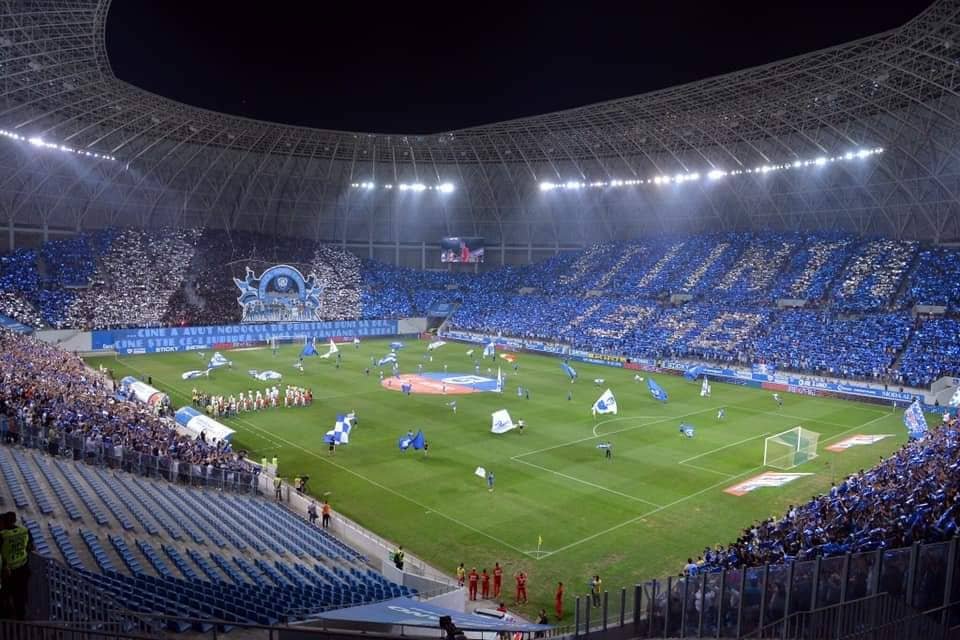
Stadionul Ion Oblemenco is a modern, properly built arena, and it is noticeably larger and better than a city of Craiova's size would ordinarily justify.
That is the first clue. Somebody decided this mattered enough to build at that scale, and nobody locally thought it was excessive. What to see in Craiova lists it, and on a matchday it is the busiest thing in the city outside the Christmas market.
Places in this piece
The reason is 1983, not 2026
The emotional core of this is not a current league position. It is the team of the late 1970s and early 1980s — the side people here still call *Craiova Maximă* — which was genuinely excellent, beat serious European opposition, and did it from a provincial Romanian city during a decade when very little good news arrived.
Craiova's maximum, 1983 is the page on that era, and it is filed under the city's history rather than under sport deliberately. It belongs with the works and the university as part of how this city understood itself at its high point.
This is the thing outsiders miss. For a generation here, the team is not entertainment. It is evidence.
The split, which you should know about before you ask
Craiova's football situation is complicated, and if you raise it casually you may get a far longer answer than you wanted.
There are two clubs claiming descent from the historic Universitatea Craiova, and the dispute has been through the courts. The name and crest were settled by Romania's High Court of Cassation and Justice in September 2017. The question of the palmares — which club inherits the historic honours — went back into re-trial and has been contested since.
We are not going to adjudicate it here. Two things are true: the legal position on the name was settled in 2017, and the palmares question has not been in the same settled state. Locals have firm views; a visitor is under no obligation to pick a side and will be happier not to.
Where to stay nearby
Live prices and availability on a map centred on this exact spot — hotels, apartments and hostels, so you can judge the walk from here rather than guess from an address.
Bookings made through this map earn us a commission. Your price is unaffected.
What this means practically
- Both have support in the city. You will see two sets of colours.
- The question "which one do you support" is not small talk. It is closer to a political question.
- Nobody will mind you not knowing. They will mind you having a confident opinion after three days.
Why a club carries this much weight here
Three reasons, and none of them are sporting.
It is the only national platform the city has. Craiova has six Brâncuși, a theatre with an international record and a park that won gold in Paris, and none of them put the city's name on national television every week. The team does.
It outlasted the factories. Electroputere employed twelve thousand people and no longer builds anything. The club is still here. In a city that lost its industrial identity in one decade, that continuity means something.
It is the one thing that cannot be ignored from Bucharest. Which, given how little anyone knows about Craiova, is not nothing.
What a matchday does to the city
It is worth knowing even if you have no intention of going in.
The centre fills from late afternoon. The old town runs at weekend density on a weekday. Taxis get scarce an hour before kick-off and for about forty minutes afterwards. Parking near the centre becomes a real exercise rather than an afterthought.
None of this is hostile or intimidating. Romanian league crowds at this level are family-heavy and the atmosphere in the city is closer to a festival evening than to anything you may be bracing for.
If you are here for the museums and an early night, simply check whether there is a home fixture and plan your dinner accordingly.
Going to a match as a visitor
Entirely doable and genuinely one of the better evenings available here.
- Check the fixture before you build a trip around it. Romanian league scheduling moves.
- The stadium is central-ish and walkable from the middle of town — see the neighbourhoods for orientation.
- Book a central room for a matchday weekend early. Where to stay.
- Eat before or after, not at the ground. Where to eat.
If you do not care about football at all
That is fine, and you will still encounter this. It comes up in taxis, in bars, in the market.
The useful framing is that it is a conversation about the city's self-image with a scoreboard attached. Why we stay covers the same emotional material without the fixtures.
The one thing to say
If you want a response that makes everybody in the room happy at once, do not name a club. Say "Craiova Maximă" and look interested.
Everyone agrees about 1983. It is the only part of this subject on which they do.