
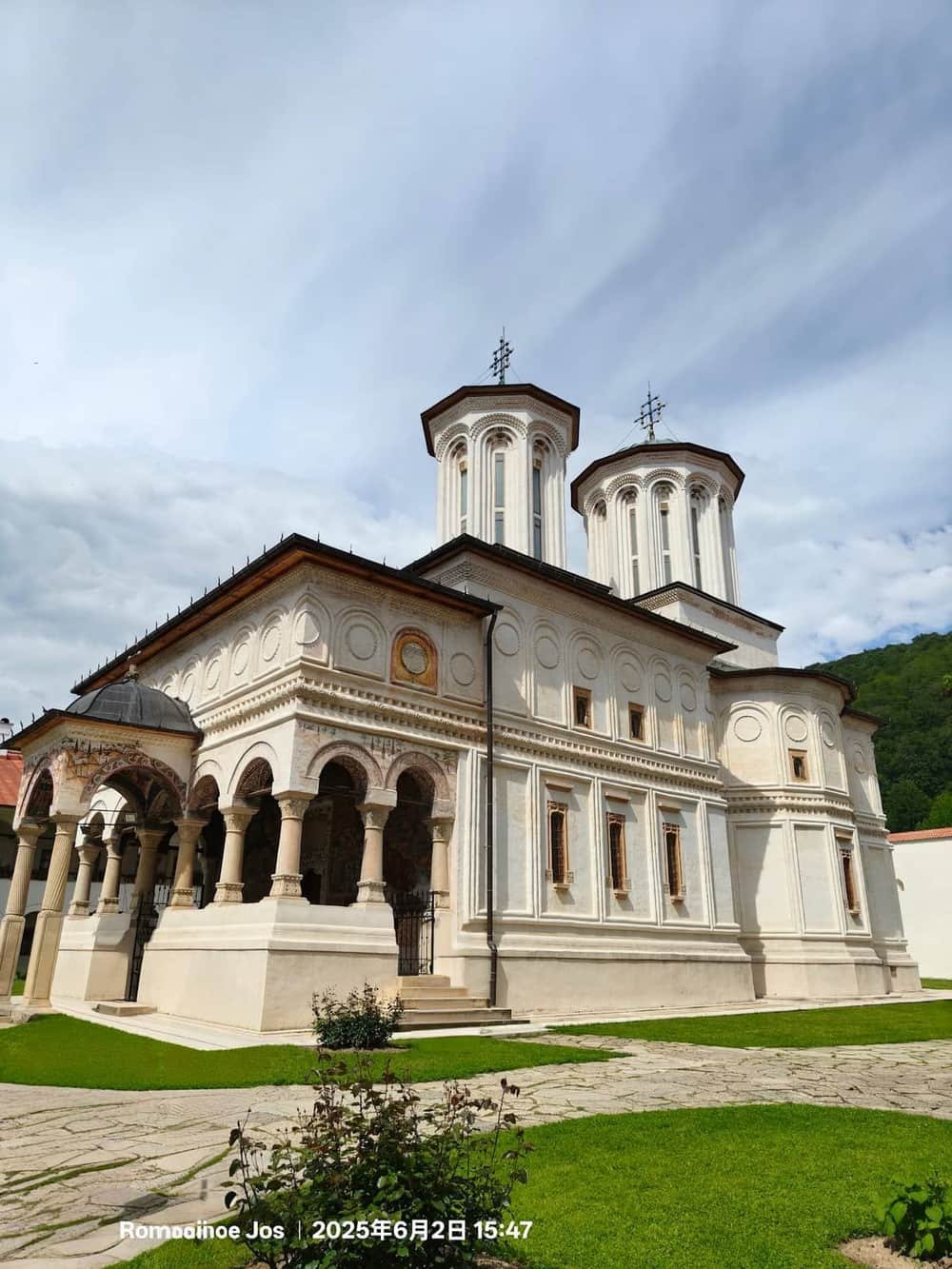
The short version
Hurezi is the largest and most complete thing Constantin Brâncoveanu built, and it is the reason there is a word for a Romanian architectural style. Founded in 1690 and finished around 1697, it survived almost untouched — which almost nothing else of that period did — and it has been on the UNESCO World Heritage List since 1993, under reference 597.
- 113 km north-east of Craiova, measured at about 1 h 57 min. No useful public transport.
- Entry to the courtyard is free. It is a working monastic community: dress modestly, and services take precedence over visitors.
- It names the Brâncovenesc style — the carved stone, the open porches, the painted narthex.
- Pairs with Peștera Muierilor at Baia de Fier on the same road, and with the Horezu potters in the village.
- Do not trust the published hours. The monastery's own page has carried a placeholder e-mail address for years.
Checked October 2026. The UNESCO reference and the construction dates are stable facts. Opening hours and any fee are not reliably published anywhere, and this page does not invent them — see the prices page.
What the Brâncovenesc style actually is
The word gets used a lot in Romanian cultural writing and rarely explained, so: Brâncovenesc is the architectural and decorative style of Constantin Brâncoveanu's reign (1688–1714), and Hurezi is its definitive statement rather than one example among several.
What to look for, in the order you will see it:
The open porch. A colonnaded, roofed, open-sided porch across the west front of the church, with carved stone columns. This is the single most recognisable Brâncovenesc feature and it is a synthesis — Italian Renaissance proportion, Ottoman decorative vocabulary, Byzantine plan — assembled into something that is neither of its sources.
The stone carving. Vine scrolls, acanthus, rosettes, cut shallow and dense into the column capitals and the door and window frames. The quality here is the highest of any surviving Brâncovenesc ensemble.
The painted narthex. The entrance chamber of the church carries a painted programme including portraits of the founder's family, which is what makes it a historical document as well as a religious one.
The scale of the whole. Hurezi is not a church with buildings round it; it is a planned complex — church, cells, kitchens, a library, a princely residence — laid out at once. That completeness is why UNESCO took it and not one of the dozen smaller Brâncovenesc churches.
Places in this piece

The founder, and why the survival matters
Brâncoveanu ruled Wallachia from 1688 to 1714 and was executed in Constantinople in 1714 along with his four sons, on the Sultan's order. The building programme stopped with him.
That is the context for the survival. A style that lasted twenty-six years, whose patron was killed and whose dynasty ended, would ordinarily leave fragments. Hurezi is the exception: the complex came through three centuries, two world wars and the communist period substantially as built. Walking it is the closest you can get to seeing what late-seventeenth-century Wallachia thought was beautiful.
Visiting
The courtyard is free. Beyond it, access to particular parts of the complex varies and is not published in any form we could verify.
Dress modestly — covered shoulders and knees, and this is enforced rather than suggested. It is a working monastic community, which means the liturgical schedule comes first; if you arrive during a service you wait, quietly, or you look at the exterior.
Allow an hour and a half. Longer if the stone carving interests you, which it should.
On the hours. We are not going to print a timetable. The monastery's own web presence has carried a placeholder e-mail address for years — the sort of detail that tells you how much weight to put on the rest of the page — and the aggregators disagree with each other. Telephone or simply go in the morning; a working monastery in Romania is open in the morning as a matter of practice, and that is the most reliable thing anyone can tell you.
This is the normal condition across Oltenia rather than a complaint about this place. The prices page explains why this site refuses to print unsourced figures at all.
Where to stay nearby
Live prices and availability on a map centred on this exact spot — hotels, apartments and hostels, so you can judge the walk from here rather than guess from an address.
Bookings made through this map earn us a commission. Your price is unaffected.
When to go
Spring and autumn. April, May, September and October — the building is at its best in low side-light, and the drive up from Craiova through Vâlcea is a genuine part of the trip in those months.
Avoid high summer afternoons. This region averages a high of 30.0 °C in July and 30.1 °C in August, and a stone courtyard at two in the afternoon is not where you want to be. Morning. Beating the summer heat has the rest of the strategy.
Winter is a fog risk, not a cold one. The valleys hold damp air for days at a stretch and January averages only 131 hours of sunshine for the whole month. Check the forecast — see Craiova in winter.
Feast days draw large crowds and are the opposite of a quiet visit. They are also the authentic version of the place, so which you want is a real choice. Dates are published locally and late; what's on lists only what has a source, and these generally do not.
Getting there, and what to pair it with
113 km north-east of Craiova, measured at about 1 h 57 min. Car trip — the public transport is not useful, and Craiova without a car is honest about which Oltenian destinations are reachable without one.
Horezu ceramics are the natural pairing and are in the village and along the road. The craft went onto UNESCO's intangible heritage list in 2012, which makes Horezu a town with two UNESCO entries — one a building, one a skill. Buying directly from a potter costs less than the roadside stalls and is the point of being there.
Peștera Muierilor at Baia de Fier is on the same road: a cave whose 35,000-year-old skull had its entire genome published in *Current Biology* in 2021. Ring it on the morning, for reasons that page sets out.
Do not try to add Târgu Jiu. The Brâncuși ensemble is two hours away on the opposite side of Craiova. Pick one side of the region per day — two days in Craiova sets out the geometry.
Staying and eating. Horezu has eight guesthouses listed, which for a town that size tells you what the traffic is — Horezu Guesthouse holds a 4.7 from over nine hundred reviews. Proper Pizza & Pasta holds a 4.8. And the guesthouses are where the genuinely Oltenian cooking is, which city restaurants only partly carry — see what to eat in Oltenia.
How it compares
Romania has better-known monasteries. The painted churches of southern Bucovina are a separate UNESCO listing and are more spectacular as painting; Horezu is more significant as architecture, and it is the one that gave a style its name.
What Hurezi has that the famous ones do not is quiet. It holds a 4.8 from under three thousand reviews — a very high rating on a modest base — and on an ordinary weekday morning in October you may have the courtyard largely to yourself. For a UNESCO site two hours from a city, that is unusual, and it is the honest reason to prefer it.










