I have had this conversation enough times to write down both halves of it. Somebody from Bucharest comes for a weekend, and over two days their opinion moves through the same four stages.
Here they are, with the parts they say out loud and the parts they say on the way to the station.
Stage one: "it's smaller than I thought"
They mean this as a neutral observation and it is not. It is the beginning of recalibration.
Craiova has around a quarter of a million people, which is a real city, but after Bucharest everything reads as compact. Within an hour somebody will say some version of "wait, is this still the centre?" — because the walkable part is genuinely small and the rest is districts they are not going to see.
Places in this piece
Stage two: "why does this look like this?"
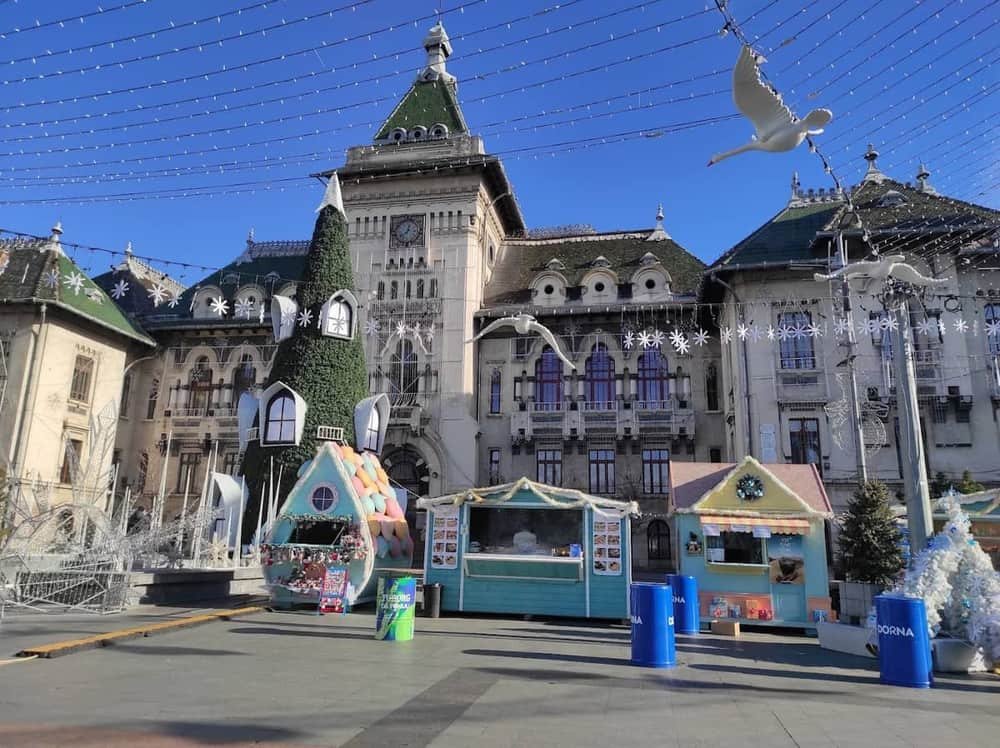
This is the good stage, and it happens on Calea Unirii.
Bucharest visitors do not expect the Belle Époque centre. They have been told Craiova is a factory town with a football team, and then they are standing in front of the Administrative Palace asking what the money was.
The answer is grain and the Danube, and the palaces page is the longer version. It lands well, because it explains both the quality and the abrupt stop in 1914.
Stage three: the museum
This is where the weekend turns.
The art museum holds six original Brâncuși. In a Belle Époque palace. With, on a normal Saturday, almost nobody else in the room.
Bucharest visitors in particular take this badly, in a specific way: they are annoyed that they did not know. It is a two-and-a-half-hour drive and nobody told them. That irritation is the single most reliable reaction this city produces.
Stage four: the park, and the arithmetic
Parcul Romanescu finishes the job. Ninety hectares, a plan that won gold at the 1900 Paris Exposition, and a Sunday crowd behaving exactly as a city should on a Sunday.
Somewhere in there the arithmetic starts. "What would a flat here cost?" They are not seriously moving. But they do the sum, and the sum is uncomfortable — what it costs to live here against what the same money buys in Bucharest.
The comparison they reach for, and why it misleads
Within a day somebody will compare Craiova to Sibiu or Brașov. It is the natural reference point, and it sets up the wrong expectation twice over.
Those cities offer a dense, restored medieval core and a mountain an hour away. Craiova offers neither. What it offers instead is a nineteenth-century boom-town centre and a park of a kind neither of them has — a different proposition entirely, built by different money in a different century.
The honest frame is not "a smaller Sibiu". It is closer to a provincial French or Italian city of the same period: a handsome commercial centre, serious institutions, good food, and no castle.
Read it that way and the weekend works. Read it as a Transylvanian city missing its old town and you will spend two days looking for something that was never there. What to see sets the right expectations.
Where to stay nearby
Live prices and availability on a map centred on this exact spot — hotels, apartments and hostels, so you can judge the walk from here rather than guess from an address.
Bookings made through this map earn us a commission. Your price is unaffected.
What they complain about, fairly
I am not going to pretend the weekend is uniformly flattering.
- The approach into the city is ugly. It is. The ring and the block corridors are not the city's best face, and first impressions suffer.
- Façade condition is uneven. Some buildings are immaculate, some are netted. The palaces page says so upfront.
- There is not much to do after eleven on a Tuesday. Craiova at night is real, but it is a weekend proposition.
- In July it is genuinely too hot. No argument.
What they get wrong
Two things, consistently.
They allocate too little time. The standard Bucharest plan is "we'll stop on the way to somewhere" and three hours. That buys the main street and a coffee. One day is the minimum; two is correct.
They try to add a day trip. Craiova plus Brâncuși at Târgu Jiu in a weekend is possible but tight, and attempting Târgu Jiu *and* the Danube means a weekend in the car — see why.
The thing they say at the station
Almost verbatim, every time: "I had no idea."
Which is, in one sentence, the whole problem and the whole opportunity — and the reason nobody knows about Craiova is the most-read thing we have written.
If you are the Bucharest visitor
A short plan that avoids all of the above.
- Come for two nights, not an afternoon.
- Do the museum first, before anything else, while you are fresh.
- Walk Calea Unirii at six in the evening, not at noon.
- Give the park an actual afternoon.
- Eat Oltenian, not international — here.
- Do not add a day trip on a two-night stay.
That is a genuinely good weekend, and it costs noticeably less than the same weekend in Brașov. Is Craiova worth a visit makes the case without the sales pitch.